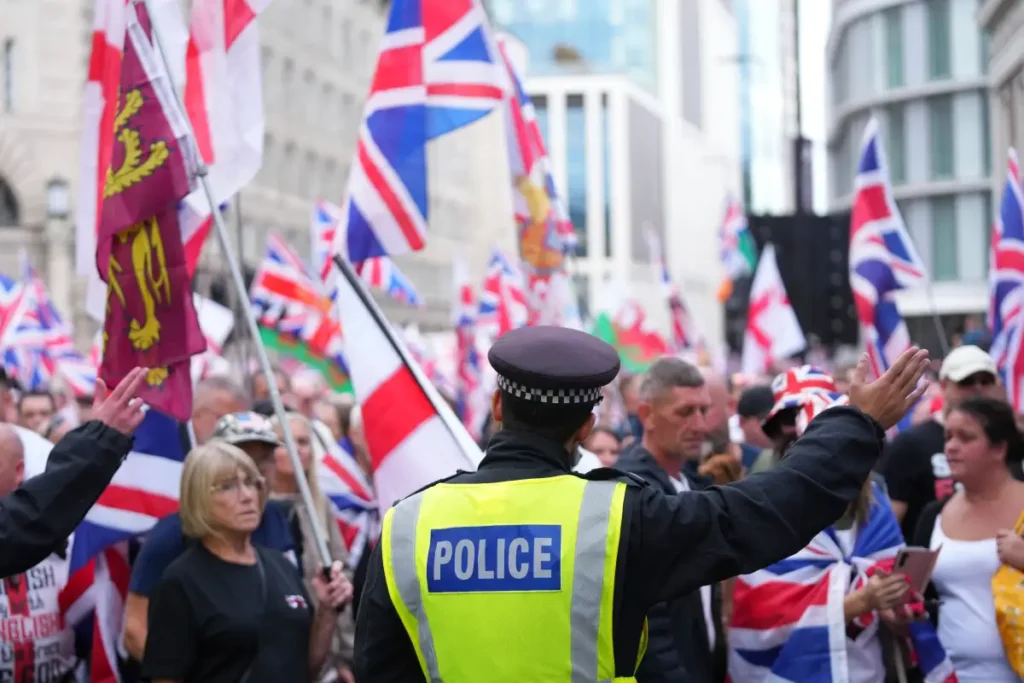
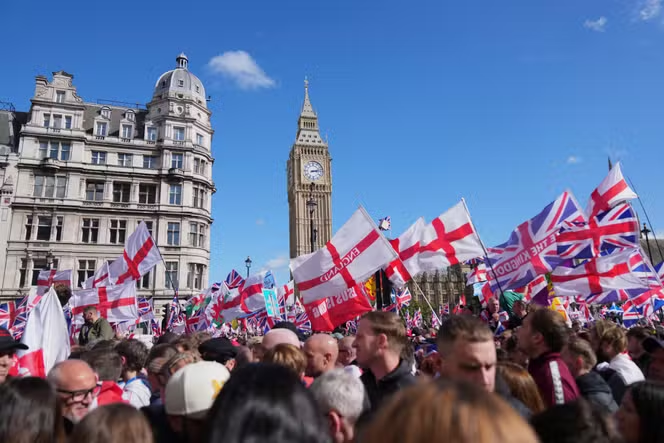
On Saturday, 13 September 2025, central London became the scene of one of the largest far-right demonstrations in recent UK history. Starting around midday, an estimated 110,000 people gathered for a rally led by Tommy Robinson, the controversial activist who has long positioned himself as a voice against immigration and what he describes as the erosion of British values.
At the same time, approximately 5,000 counter-protesters mobilised under the banner of March Against Fascism, sending a strong message of opposition to Robinson’s movement and calling for unity, inclusion, and support for migrant communities.
The Rally: “Unite the Kingdom”
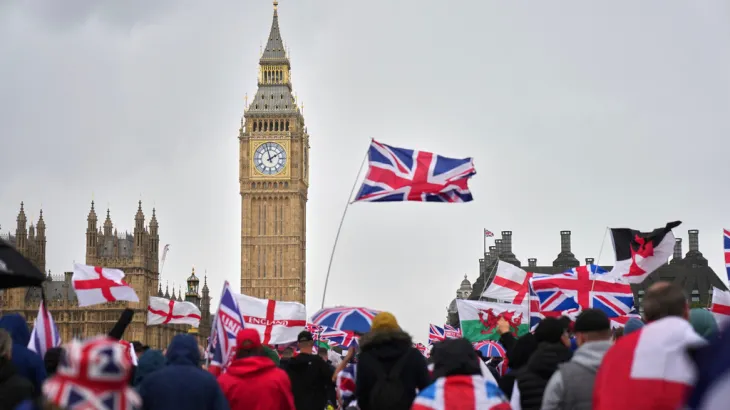
Robinson’s rally, branded Unite the Kingdom, drew supporters from across the country. Many waved Union Jacks and St George’s Cross flags, while chants and placards highlighted anger over immigration, asylum policies, and perceived failures of political leaders to “protect Britain’s borders.”
For Robinson and his followers, the reasons for the rally were clear:
- Immigration Control: A demand for stricter border enforcement and the deportation of people living in the UK illegally.
- National Identity: Calls to protect traditional British and English cultural values, often framed as being under threat.
- Free Speech: Robinson has long claimed that his views are unfairly silenced by mainstream media and politicians. Many attending the rally saw their participation as a statement in defence of free expression.
- Disillusionment with Politics: The event also tapped into wider frustrations with both major parties, with attendees arguing that politicians ignore “ordinary voices” on issues like migration, crime, and community security.
The rally had an emotional edge, with references made to the recent death of American conservative activist Charlie Kirk, which Robinson described as a rallying cry for continuing the fight for “Western values.”
Counter-Protest: “March Against Fascism”
While Robinson’s supporters gathered in vast numbers, thousands of counter-demonstrators staged a protest in another part of London. The event, March Against Fascism, was organised by anti-racism groups, trade unions, and community organisations.
Their reasons for protesting were equally strong:
- Rejecting Racism and Division: Marchers condemned what they see as Robinson’s divisive and exclusionary rhetoric.
- Defending Migrants and Refugees: Protesters carried signs and chanted in support of migrants and asylum seekers, stressing that immigration enriches British society.
- Promoting Unity and Diversity: The demonstration highlighted values of multiculturalism and social solidarity as the true identity of modern Britain.
The counter-protest, though smaller in size, was vocal and determined, ensuring Robinson’s message did not go unchallenged.
Tensions, Clashes, and Police Presence
With both events happening on the same day, the Metropolitan Police faced a major operation. More than 1,600 officers were deployed across central London to keep the two groups apart. Barriers were set up and cordons enforced, but despite these precautions, flashpoints of violence erupted.
- Groups of Robinson’s supporters attempted to break through police lines.
- Bottles, cans, and flares were thrown in confrontations with officers.
- Several arrests were made, and some officers sustained injuries.
The scenes highlighted the difficulty of policing an event of this scale, particularly when emotions were running so high.
Wider Context and Reasons Behind the Turnout
The enormous turnout for Robinson’s rally reflects several broader issues in UK society:
- Immigration and Asylum Debate
With ongoing debates about asylum seekers arriving across the English Channel and the costs of housing migrants, immigration has become one of the most contentious topics in UK politics. Robinson has capitalised on this anger, turning it into mass mobilisation. - Discontent With Politics
Many attendees expressed frustration not just with immigration but with the political establishment as a whole. For them, both Labour and Conservative governments have failed to deliver on promises to control borders or strengthen national security. - Identity Politics and Nationalism
Robinson’s movement speaks to individuals who feel their cultural identity is being diluted. Flags, chants, and national symbols dominated the march, showing that for many, the rally was about asserting a sense of pride and belonging. - The Power of Social Media
Robinson has built a large following online, bypassing traditional media. The rally’s organisation relied heavily on social media promotion, tapping into networks of supporters across the UK and beyond.
Implications Going Forward
The events of 13 September 2025 will likely have lasting consequences:
- Political Fallout: The sheer size of the rally will force politicians to address growing discontent around immigration and national identity.
- Policing and Public Order: With injuries and arrests reported, questions will be raised about how demonstrations of this scale should be managed in the future.
- Social Cohesion: The sharp contrast between Robinson’s rally and the counter-protest underscores deep divisions in British society. Bridging these divides will be one of the country’s greatest challenges moving forward.
Conclusion
The “Unite the Kingdom” rally has made headlines not only for its scale but also for the passion and anger it revealed. Supporters saw it as a defining moment in their fight for borders, culture, and free speech. Opponents saw it as a dangerous step toward normalising far-right politics.
What is clear is that the events of 13 September 2025, from noon until late evening, will be remembered as a turning point in the UK’s debate over identity, immigration, and the future of its political landscape.